

Chapter 11 of 19 The world
The horse
Sooner or later our Warden gets tired of walking from one end of the Valley to the other. A horse takes you between zones much faster, and from the second grade on you can fight from the saddle with the horse's bow.
The three grades
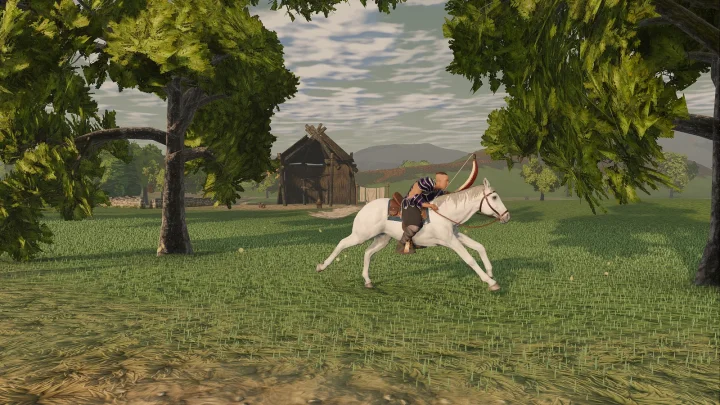
A horse has three fixed grades, and each one runs faster than the last:
- Foal
- quick, but you cannot attack from its back.
- Palfrey
- faster, and from the saddle you shoot with the horse's bow.
- Destrier
- the fastest of all, with a run of its own, full tilt.
How you get one
The Stableman gives you the three grades one at a time, through quests of the main chain. Each time he wants the head of the boss of one floor of the Kobold Caves: the first floor at level twenty eight for the foal, the second at level forty for the palfrey, the third at level fifty two for the destrier.
With each grade the Stableman gives you what you need to call it: the Foal Drawing, then the Palfrey Manual, then the Destrier Manual. Each one replaces the one before, and if you lose it he makes you another for a fee.
Before you have a horse of your own, from level ten, he lends you one: give him a Riding Voucher and you ride for a short while, once an hour. On a borrowed horse you cannot attack. Your Wooden Casket holds ten of them.
Riding
Use the drawing or the manual from your bag to call your horse; it costs a little mana. When it stands next to you:
- Ctrl+H gets you in the saddle or down;
- Ctrl+F feeds it;
- Ctrl+B sends it back.
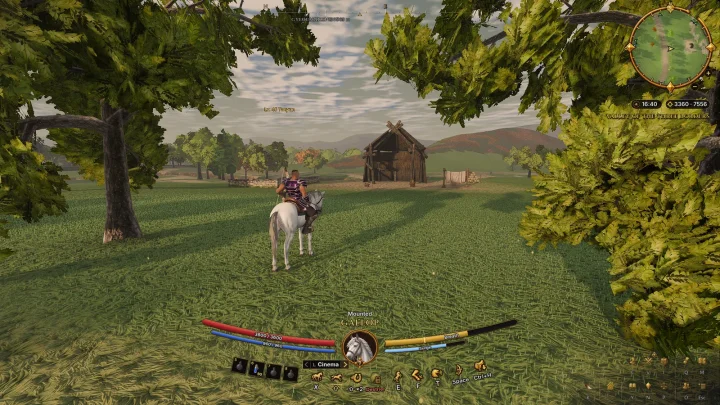
In the saddle the bottom of the screen changes: your health and mana on the left, your horse's Breath and Surge on the right, its portrait with the gait in the middle, and under it the actions with their keys.
Gaits
X switches between the two easy gaits, the trot and the canter, and you mount at the canter. Shift takes your horse into a gallop and back, and Shift pressed twice quickly gives a short sprint.
Galloping and sprinting use up Breath. It comes back at the slowest gait and standing still; when it runs out, your horse drops to an easy gait and will not gallop again for a while.
A destrier also has full tilt R, the fastest run there is. It starts from a gallop and burns Surge, which fills up only while you gallop. While it lasts Breath stays where it is, and leaving the gallop ends it.
Fighting in the saddle
From the palfrey up, the horse gives you a bow. It appears when you mount and goes away when you get down, and it is not an item. Whatever weapon you carry, in the saddle you shoot with that bow Space. An arrow deals the damage of your basic attack with the gear you have on, plus a small bonus that grows from the palfrey to the destrier, and the faster you attack the more often you shoot.
No class has skills in the saddle, and no buff can be cast there. The ones you cast on foot stay on and work for your arrows too. Against bosses an arrow does half damage and gets no bonus from the horse: get down and face them on foot.
Falling
A heavy blow leaves you off balance, and the saddle bar says so. Take another while you are off balance and you fall; a very heavy blow throws you down at once. Poison and fire do not count. If you fall from your own horse it stays beside you, but you need a moment before you can get back on.
Gestures and the cinema camera
Standing still, your horse has three gestures everyone around can see: E it rears, F it kicks, T it neighs. They are only for show.
In the saddle the cinema camera stays beside your horse, on the side you choose: the left arrow key puts it on the horse's left, the right arrow key on its right. L turns it off for the classic camera you use on foot, and on again. You find the same switch, and the side, in the Options under Controls. The three buttons next to your horse's portrait do the same with a click.
Your horse's looks
Bo-seok, the saddler, trades looks for your horse for the ores you dig: coats, manes and tails, saddles, reins, caparisons and more. Use the item once and the look is yours for good, then choose it in the Stable, from the button on your horse's panel. Barding, caparisons and hoofprints show from the palfrey up, and full barding only on a destrier.
Looking after it
Riding tires your horse, and it rests when you are not using it. If it does not eat, its health drops over time, and in the end it can die. The Stableman sells the food, the Bundle of Dry Hay for the foal, the Stable Carrot for the palfrey and the Red Root for the destrier, and the grasses that bring a fallen horse back. He also sells the Stableman's Sugar Lump: click your horse, choose to give it a name, and the lump is used up when the name is accepted.
Besides your horse there are other mounts, which you call with a whistle or a seal from your bag. The Collection K lists them in its second tab.
The keys of this chapter
- Ctrl+H
- gets you in the saddle or down.
- Ctrl+F
- feeds the horse.
- Ctrl+B
- sends it back.
- X
- switches between trot and canter.
- Shift
- takes you to the gallop and back; pressed twice quickly, a sprint.
- R
- full tilt, on the destrier.
- Space
- shoots with the horse's bow.
- E F T
- rear, kick and neigh, standing still.
- L
- turns the cinema camera off and on; the arrow keys choose its side.